

How to Hang Carpets on Wall Without Damaging Them
To hang a carpet on the wall without damaging it, never drive nails, tacks or staples through the carpet itself. Spread the weight along the whole top edge instead, using one of three methods: a sewn Velcro strip, a fabric sleeve with a rod through it, or a wooden clamp. Pick by weight.
A carpet is not a picture frame. A frame hangs from two points because its own structure carries the load. A carpet has no structure of its own, so any method that holds it at two points puts the entire weight on a few knots. The weave pulls, the corners stretch, and the damage does not come back out. Every method below exists to turn two points of load into a continuous line of load.

| Method | Best for | Needs sewing | Reversible | Difficulty |
|---|---|---|---|---|
| Velcro strip | Light to medium carpets, flatweaves | Yes, onto a cotton sleeve | Yes, lifts straight off | Medium |
| Sleeve and rod | Medium to large carpets | Yes, a fabric sleeve | Yes, slide the rod out | Medium |
| Wooden clamp | Heavy, thick or antique carpets | No | Yes, unbolt the strips | Harder, needs two people |
| Clips or clamps | A quick or temporary display | No | Yes | Easy |
| Tension rod | An alcove, niche or framed opening | Yes, a sleeve | Yes, nothing enters the wall | Easy |
| Float-mount frame | Small carpets and fragments | No | Yes | Needs a framer |
| Layering | Showing a carpet with no fixings at all | No | Yes | Easy |
Conservation practice treats this as the default for heavy flat textiles. The Canadian Conservation Institute recommends a Velcro support for tapestries, wall hangings, rugs and quilts that are in good condition and can carry their own weight, because the load spreads evenly across the full width rather than gathering at a few points.
Which Wall Are You Hanging It On?
Most guides to this job tell you to find the studs in your wall with a stud finder. In a Dubai home that advice usually leads nowhere, because there are no studs to find.
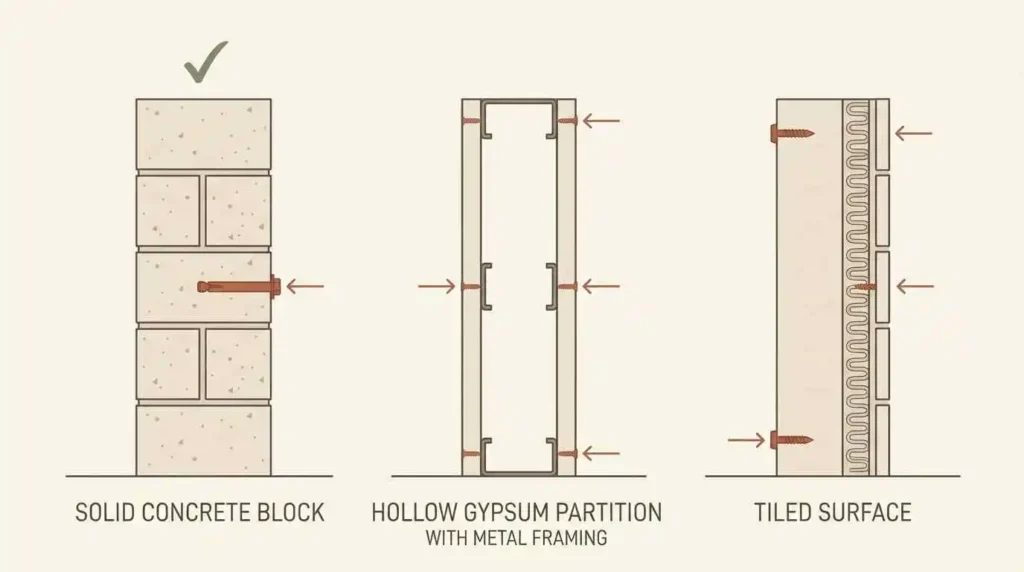
Builders here use concrete and block for the structural walls, and gypsum board for internal partitions. So before choosing a hanging method, work out which of three surfaces you are drilling into. The method you pick for the carpet barely changes; what changes is the fixing that holds it up.
| Wall | How to tell | What it means for fixing |
|---|---|---|
| Concrete or block | Knock on it and it sounds solid. The drill will not go in without a hammer setting | Holds the most weight. Needs a masonry bit and the right plug |
| Gypsum partition | Knock on it and it sounds hollow. It is usually an internal dividing wall | Will not hold weight on a plain screw. Needs a cavity fixing, or you must find the metal framing behind it |
| Tiled or marble surface | Visible from the finish | Avoid. Drilling risks cracking the tile, and the fixing has to pass through to what is behind it |
A gypsum partition is where the heavy carpets go wrong. A plain plug in gypsum board pulls out slowly, often weeks later, and takes a patch of the wall with it. If the wall sounds hollow and the carpet is heavy, either move it to a solid wall or use the right cavity fixing for the weight.
If you cannot tell what you are dealing with, ask someone who drills into these walls for a living. A team that does carpet fitting in Dubai every week knows what is behind the paint in most buildings here, and will usually know from the first hole.
Fixing the Batten or Brackets Into the Wall
Two rules cover the hardware. The masonry bit diameter matches the plug diameter, and the screw is one size smaller than the plug.
the screw is one size smaller than the plug.
| Plug colour | Masonry bit | Screw gauge |
|---|---|---|
| Yellow | 5 mm | No. 4–8 |
| Red | 6 mm | No. 6–10 |
| Brown | 7 mm | No. 8–14 |
| Blue | 10 mm | No. 14–18 |
Drill about 10 mm deeper than the plug is long, so that dust sitting at the bottom of the hole does not stop the plug seating. Never drill the hole undersize: forcing an oversized plug in shears its fins off, and it then spins in the hole instead of gripping.
Work out the weight before you choose the plug. A wool carpet weighs roughly 2.5 to 3.7 kg per square metre, so a 2 by 3 metre piece lands somewhere around 15 to 22 kg. Put it on a bathroom scale if you can, because that is a better number than any estimate.
Take the load figure from the plug’s own packaging, not from a colour chart. Published charts disagree with each other — one puts a brown plug at about 25 kg per fixing in solid brick, another at about 60 kg, and at least one states outright that its figures are indicative and not a load rating. The figure that matters is the one the manufacturer gives for that plug in your base material, and the gap between solid concrete and hollow block is wide. If the drill suddenly breaks through into a void, you are in hollow block, and a nylon plug there holds far less than a chart for solid masonry suggests.
Spread the load across several fixings. The batten carries the carpet along its full width, so what you are sizing is the number of fixings holding the batten up. Put one near each end, space the rest evenly between them, and make sure their combined rated load sits comfortably above the weight you measured rather than just matching it. Nylon plugs also have a ceiling: fixing guidance warns against relying on them where a failure could cause a fall or an injury, which is worth keeping in mind for a heavy carpet over a sofa or a bed.
Which Carpets Can Be Hung?
Not every carpet belongs on a wall. Conservation guidance sets two conditions: the piece must be in good condition, and it must be able to carry its own weight. A soiled or damaged textile should not be mounted at all — clean it, repair it, or ask a specialist first, because hanging accelerates whatever is already wrong with it.
| Carpet | Suits wall hanging | Method to use |
|---|---|---|
| Flatweave or kilim | Yes, the easiest case | Velcro, or a sleeve and rod |
| Medium-pile wool | Yes | Any of the three, chosen by weight |
| Thick or heavy pile | Yes, with care | Wooden clamp, or a sleeve with a centre bracket |
| Silk | Only with a lined sleeve | Sleeve and rod, away from all direct light |
| Tufted, with a glued backing | Only if the backing is sound | Sleeve stitched into the primary backing, or a clamp |
| Soiled, worn or damaged | No | Clean or repair it first |
How Do You Prepare the Carpet and the Wall?
Four steps before anything goes into the wall.
Clean it first. A carpet on a wall is far harder to clean than one on the floor, and most people never clean it again. Have it cleaned before it goes up.
Let it flatten on its own. Lay the carpet flat for a few days so that floor creases settle out. Do not apply direct heat to speed this up, which can melt a synthetic backing and damage natural fibres.
Work out the height. Galleries and museums place the centre of a piece 57 inches (145 cm) from the floor, which matches average adult eye level, and 57 to 60 inches (145 to 152 cm) is the usual working range. To find where the top edge sits, add half the carpet’s height to 57 inches. Over a sofa or console, keep the bottom edge 6 to 12 inches clear of the furniture instead.
Mark it with a level. Mark the full line of the batten or brackets with a spirit level before drilling. A carpet hung a degree off is obvious on the wall in a way it never is on the floor, and on an uneven ceiling line you may need to follow the room rather than the level.
Method 1: The Velcro Strip
This is the safest method for most carpets, and the one to default to if you are unsure.
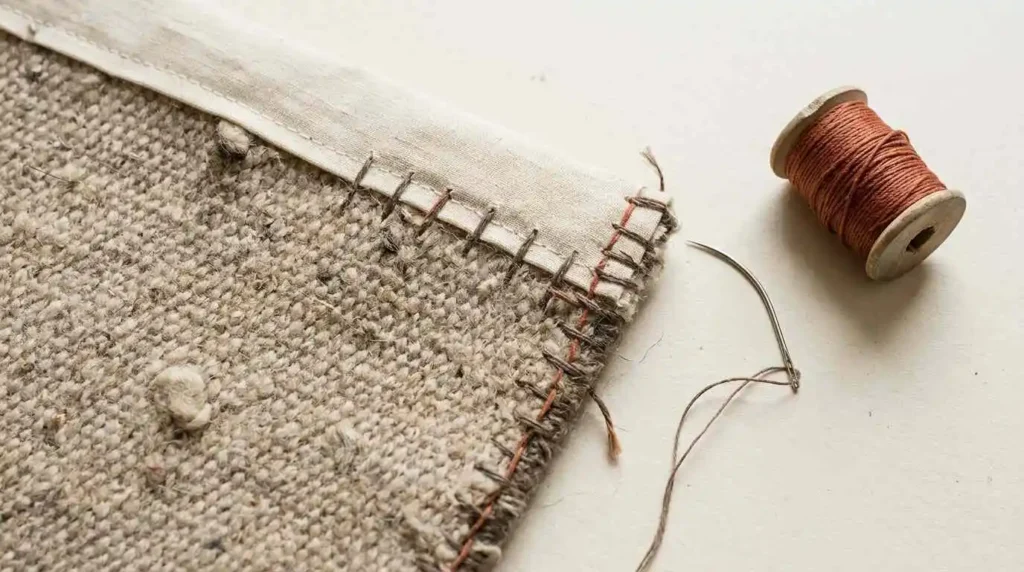
- Cut the hook-and-loop tape 2 cm shorter than the width of the carpet’s top edge. Tape from 1.9 cm to 5 cm wide covers most carpets.
- Machine-stitch the loop side of the tape onto a sleeve of prewashed cotton, cut 0.5 cm wider all round than the tape. Then hand-sew that sleeve to the back of the top edge with a curved needle and strong thread, stitching into the backing only so nothing shows on the front. Do not stitch the tape straight onto the carpet: it is stiff enough to stress the fibres along the seam, which is the reason the cotton sleeve sits between them.
- Mount a flat wooden batten to the wall, the same width as the carpet, fixed into the wall as the surface requires.
- Attach the stiff hook side of the tape to the batten.
- Press the carpet onto the batten, starting at one end and working across.
Two things ruin this method. The first is self-adhesive Velcro stuck straight onto the carpet backing, where the glue works into the fibres and cannot be removed. Sew the tape on instead. The second is raw, untreated wood touching the carpet, which damages the fibres over time. Seal the batten, or put a layer of unbleached cotton between the wood and the carpet.
The method is fully reversible. The carpet lifts off the wall, and if you want it back on the floor later, only the sewn strip remains.
Method 2: The Sleeve and Rod
Better for larger carpets, and the method that gives the cleanest finished look.
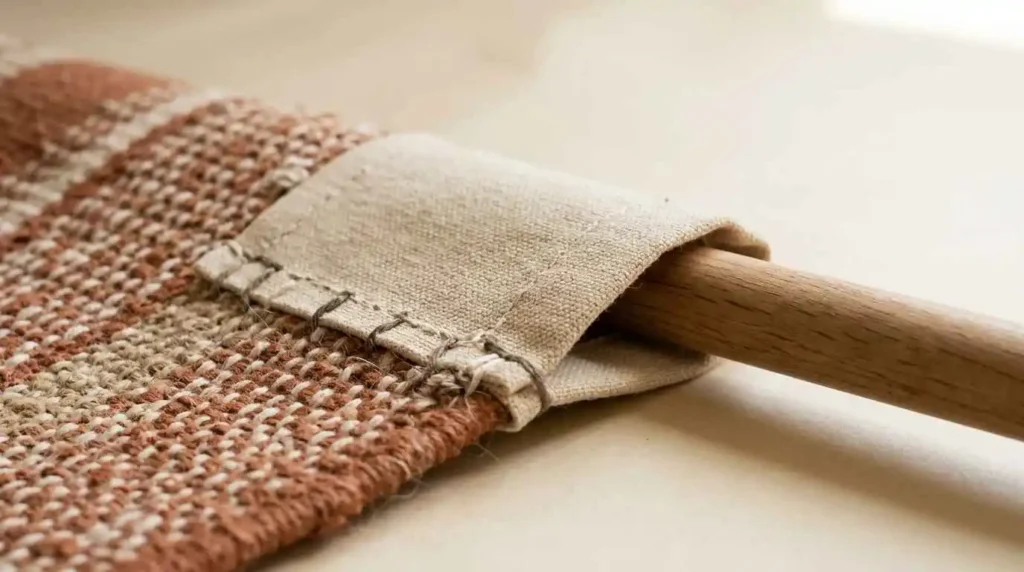
- Cut a strip of strong cotton canvas slightly narrower than the carpet, with no adhesive on it.
- Hand-stitch it across the back of the top edge to form a loose tube, leaving enough slack for a rod to pass through. Stitch into the backing only.
- Slide a wooden dowel or metal rod through the tube.
- Fix two brackets to the wall and rest the rod on them.
The rod has to be strong enough not to bow in the middle. A rod that sags puts the load back onto two points, which is the problem the method is meant to solve. For a wide carpet, add a third bracket in the centre.
For an antique or high-value carpet, the canvas sleeve matters for a second reason: it keeps the rod from touching the carpet at all. Paint or seal a wooden rod before use, so that nothing acidic sits against the fibres, and check a metal rod for rust.
If you would rather not sew it yourself, specialist carpet and rug cleaners will often attach a hanging sleeve as a service.
Method 3: The Wooden Clamp
For heavy, thick or antique carpets, where sewing is either not enough or not advisable.
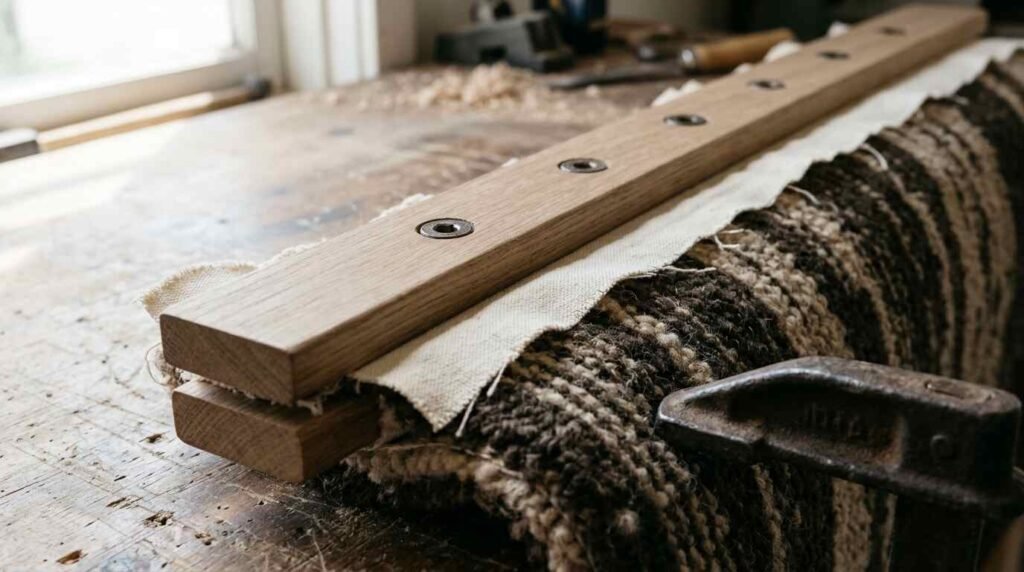
- Cut two smooth wooden strips slightly longer than the carpet is wide.
- Lay the top edge of the carpet between them, with unbleached cotton cloth as a buffer on both sides if the wood is rough or untreated.
- Bolt the two strips together through the carpet’s top border, countersinking the hardware so nothing protrudes.
- Hang the whole assembly from wall fixings rated for the weight.
The clamp carries the load across its full length, which is why it handles weight the other two methods cannot. It needs two people for anything large, and it is the method where the wall fixing matters most — the carpet will not fail, so the wall is the weak point.
Clips and Clamps: The Quick Option
Clips hold the top edge without any sewing, which makes them the easiest choice for a temporary display or a rented home.
Use padded contact points, and spread the clips across the full width so that no single clip takes concentrated pressure. Do not add grommets or eyelets to a carpet unless a textile specialist has assessed the carpet and prepared it for them, and never glue a carpet directly to a wall — both are permanent, and both devalue the piece.
Three Options That Need Nothing Drilled
A tension rod in an alcove. If the carpet is going into an alcove, a niche or any framed opening, a tension rod braced between the two side walls carries a sewn sleeve with nothing fixed into the wall at all. This is the best option in a rented apartment, and it works on a tiled or marble recess where drilling is a bad idea.
A float-mounted frame. For a small carpet, a fragment or a piece you want protected from dust, a framer can float-mount it on an acid-free backing board. Leave an air gap between the glazing and the pile, and ask for UV-filtering glass if the wall takes any daylight.
Layering. The simplest option: lean or lay the carpet over a larger piece, a bench back or a console, so that it is displayed without being fixed to anything. Nothing touches the wall, and the carpet can move whenever you want.
A Word on Tack Strips
Several guides recommend tack strips as the budget method — a wooden strip with upholstery nails or spikes that grips the carpet’s back. It is cheap and it holds.
It also works by pushing hundreds of small points through the back of the carpet, which is the one thing every method above is designed to avoid. The same applies to the spiked gripper strips used to fix wall-to-wall carpet to a wall. For a cheap machine-made rug you are happy to treat as disposable, the trade is yours to make. For anything hand-knotted, antique, silk or valuable, it is the method that quietly ruins the piece, and the damage shows when you take it down.
How to Hang a Small Carpet on a Wall
A small carpet is the easiest case, and the one where people overbuild. Velcro on a single batten is enough, and clips work for a temporary display.
The mistake with small pieces is framing them badly. If you want a small carpet behind glass, leave an air gap between the glass and the pile, and do not press the textile flat against the glazing. A compressed pile flattens permanently and traps moisture against the fibres.
How to Hang a Heavy Carpet on a Wall
Weight is what decides the method, and a heavy carpet rules out the shortcuts. Use the wooden clamp, or a sleeve and rod with a centre bracket added.
With a heavy carpet, the carpet is rarely what fails. The wall fixing is. Work out roughly what the piece weighs before buying any hardware, choose fixings rated above that weight, and treat a hollow gypsum partition as unsuitable unless you are fixing into the framing behind it.
Never hang a heavy carpet from its two top corners, and never from the fringe or tassels. The fringe is a finishing edge, not a structural one, and the weight will pull it out of the body of the carpet.
How to Hang Silk Carpets
Silk is the one case where you should consider not doing it yourself.
Silk is lighter than wool, so weight is not the problem. The problem is that silk shows every stress point, marks where it is handled, and fades faster in light than wool does. A stitch line that would disappear into a wool backing can remain visible on silk.
For a silk carpet, use a sewn sleeve with a soft canvas lining so that nothing rigid touches the pile, keep it out of direct sunlight entirely, and ask someone who works with silk to attach the sleeve if the piece has any real value. Avoid Velcro directly against silk, and avoid clips, which concentrate pressure in small areas.
The same applies to fine antique wool carpets. If the piece is valuable enough that damage would matter, paying a specialist to mount it properly costs less than getting it wrong.
What Mistakes Damage a Carpet?
| Mistake | What happens |
|---|---|
| Nails, tacks or staples through the carpet | Tears the foundation and leaves permanent stress rips |
| Hanging from the two top corners | The weave distorts and the corners stretch out of shape |
| Hanging from the fringe or tassels | The fringe pulls away from the body of the carpet |
| Carpet gripper strips | The spiked strips used for floor-to-ceiling wall carpet shred the back of a fine carpet |
| Glue or self-adhesive tape on the back | Works into the fibres and cannot be removed |
| Grommets added without preparation | Permanent holes through the textile |
| Raw, untreated wood against the pile | Damages the fibres over months rather than days |
All of these have the same shape as a problem: they concentrate load or chemistry in one small area. Anything that spreads the weight along the top edge and keeps hard materials off the pile is safe.
Where Should You Hang a Carpet?
The wall you choose matters as much as the method, and in this climate it matters more than most guides allow for.
Keep it out of direct sun. A wall that takes direct afternoon sun will fade a wool or silk carpet unevenly, and the faded edge is usually the one that was closest to the window. The fading is not reversible.
Keep it away from the air conditioning. A carpet hung directly in the path of an AC vent gets a constant dry draught across one area. Over time that dries natural fibres and makes them brittle. The same applies to anything that blows warm air at it.
Think about cleaning before you hang it. A carpet on a wall is harder to clean than one on the floor, and most people never clean it again. Have it cleaned before it goes up, and plan to take it down occasionally rather than leaving it in place for years.
Size it to the wall. Let the carpet sit comfortably within the wall rather than filling it edge to edge. A large piece on a small wall reads as cladding; a small piece on a large wall disappears.
How Do You Look After a Carpet on the Wall?
A carpet on a wall gets forgotten, and that is what damages it over a few years rather than a few days.
- Dust it with a soft brush or a vacuum on low suction, in the direction of the pile. Do not beat it while it hangs.
- Check the top edge for sagging every few months. A sleeve pulling away or a rod starting to bow are both easy to fix early and expensive to fix late.
- Turn the carpet end to end once or twice a year so that light and dust do not always fall on the same side.
- Take it down for a proper clean on a regular schedule rather than leaving it up indefinitely.
Frequently Asked Questions
What can I use instead of nails on the wall?
Use a wooden batten with sewn Velcro, a rod on two brackets, or clips. All three hold the carpet without anything passing through it. The batten or brackets still need a fixing in the wall, so match that fixing to the wall: a masonry plug for concrete and block, a cavity fixing for a hollow gypsum partition.
How do I hang a carpet with fringe on the wall?
Hang it from the top edge of the carpet itself and let the fringe hang free. The fringe cannot carry weight. If the fringe is at the top and you want it visible, mount the carpet from the woven edge just below it.
Can I hang a carpet without sewing anything?
Yes. Clips or clamps along the top edge need no sewing, and a wooden clamp bolts around the top border rather than through the weave. Both are reversible. Sewing gives a cleaner result and spreads the load better, which is why it is worth it for anything you intend to leave up.
How do I hang a tufted carpet on a wall?
Tufted carpets have a glued backing that is weaker than a woven one, so avoid anything that pulls on the backing alone. A sewn sleeve that catches the primary backing, or a wooden clamp across the top border, spreads the load best. Do not rely on adhesive on the back.
Will hanging a carpet damage the wall?
The fixing holes will. Everything else is reversible. On concrete or block the holes fill and repaint easily. On a gypsum partition a failed fixing can take a patch of board with it, which is a bigger repair, so get the fixing right the first time.
Can I put a carpet back on the floor after hanging it?
Yes, with every method here, which is the reason to use them. A sewn Velcro strip or sleeve stays on the back and is not visible in use. Nails, glue and grommets are the methods that make the decision permanent.
How high should a carpet hang on the wall?
Put the centre of the carpet 57 inches (145 cm) from the floor, which is the height galleries and museums use because it matches average adult eye level. Anywhere from 57 to 60 inches (145 to 152 cm) works. To find where the top edge goes, add half the carpet’s height to 57 inches. Above a sofa, keep the bottom edge 6 to 12 inches clear of the furniture instead.
How far apart should the fixings be?
The carpet itself should hang from continuous support, not from separate points — a batten running the full width of the carpet, or a rod on brackets. What needs spacing is the fixings holding that batten or those brackets into the wall, and the right spacing depends on the weight of the carpet and what the wall is made of. A rod must not bow in the middle, so add a centre bracket on anything wide.
Can I hang a carpet in a rented apartment?
Yes, and you can do it without drilling. A tension rod braced inside an alcove, padded clips on an existing rail, or simply layering the carpet over furniture all avoid putting anything into the wall. If you do drill, concrete and block patch and repaint easily; it is a hollow gypsum partition that leaves the repair a landlord notices.